VTEX FastStore

VTEX FastStore Implementation for high-performance e-commerce.

Implement or migrate your storefront to VTEX's headless technology with a team specializing in architecture, integrations, shopping experience, technical SEO, and continuous evolution.

e-Plus has been a VTEX partner for over 10 years, serving projects ranging from accelerated B2C projects using Fast Layout to B2B and omnichannel operations with advanced integrations and business rules.

+10 years partnership with VTEX
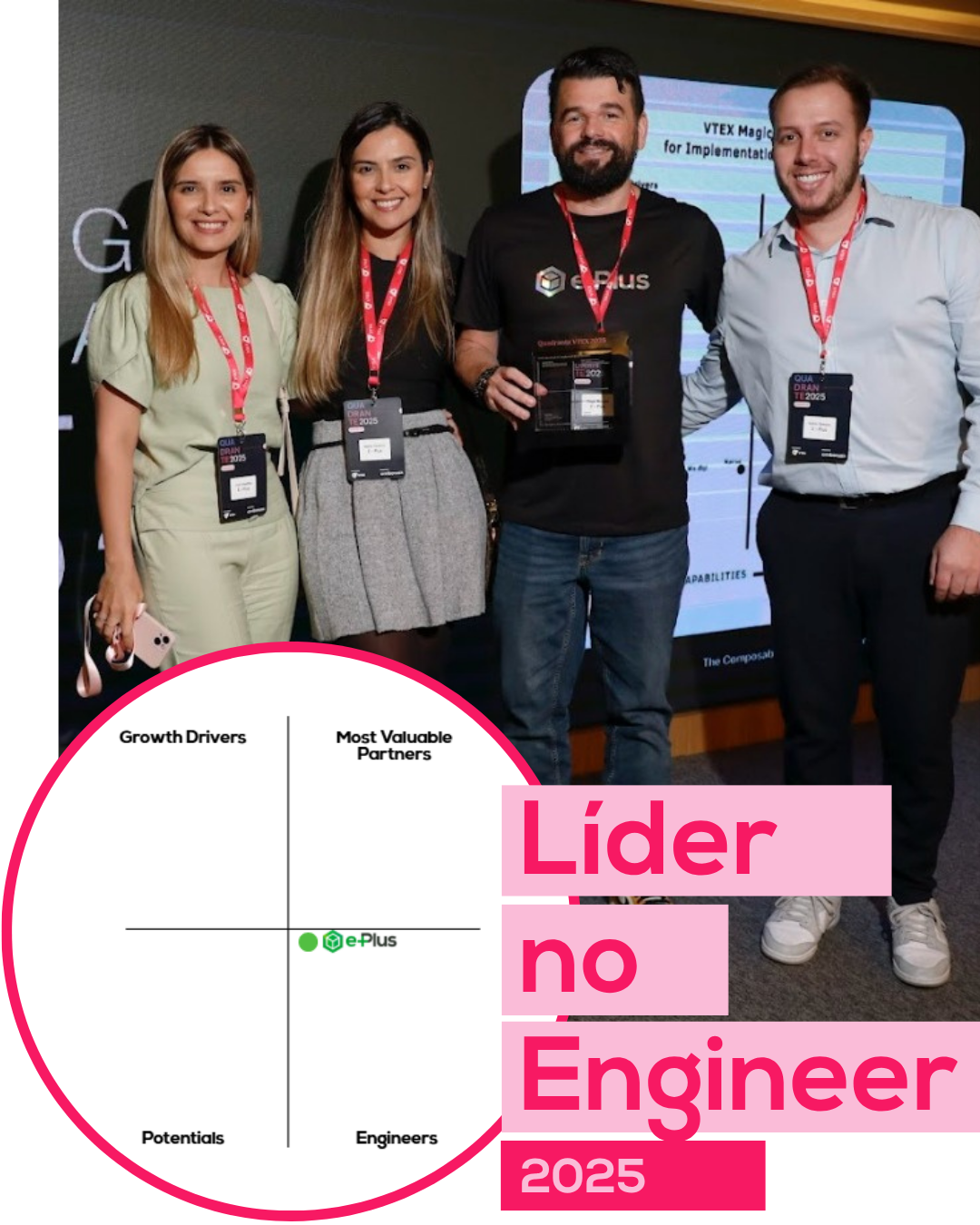
VTEX quadrant official recognition
~ 95/100 VTEX benchmark target
B2C · B2B · Omnichannel operating models
VTEX FastStore
8,4 % higher conversion rate observed in Google/Deloitte study (retail, mobile)
Understand the technology

What is VTEX FastStore?

VTEX FastStore is VTEX's headless storefront framework, developed with React, Next.js, GraphQL, and Jamstack architecture. It separates the shopping experience from the platform's commerce services, allowing you to create fast, customizable stores integrated with VTEX's catalog, search, checkout, and other capabilities.

The VTEX Commerce platform for B2C, B2B, and omnichannel operations.
The storefront FastStore VTEX's headless framework for building the shopping experience.
Who implements and evolves e-Plus Architecture, experience, development, integrations, go-live, and continuous evolution.

Performance by default

Architecture developed with a focus on speed and stability, with automated Lighthouse testing and quality control before deployments. The final result also depends on content, integrations, scripts, and implementation decisions.

Headless and flexible

The storefront is decoupled from VTEX commerce services. This allows you to customize the experience and evolve the front-end without rebuilding the entire operation.

SSG and Jamstack

FastStore combines static generation, server-side rendering, and dynamic content as needed for each page, reducing latency and improving stability during periods of high traffic.

Technical SEO

Support for titles, descriptions, metadata templates, canonical tags, and search engine-accessible HTML content. The implementation should complement this foundation with information architecture, content, and structured data.

CMS for the business team

Content, pages, and sections can be managed by the VTEX CMS, with an integrated workflow for editing, previewing, and publishing within the project.

Integration into the VTEX ecosystem

Integration with VTEX services and APIs, including catalog, checkout, search, session, pricing, and promotions, as well as the ability to connect ERPs, PIMs, CRMs, and third-party services.

Why does this turn into money?

The mathematics of performance is the mathematics of conversion.

Speed ​​isn't a technical vanity feature—it's one of the metrics most correlated with e-commerce conversion. That's why performance is at the heart of the FastStore architecture, not an extra feature.

8,4 %

The increased conversion rate observed in a Google and Deloitte study, after a 0,1s improvement in mobile speed for retail websites — is not a guarantee of results for individual projects.

53 %

According to data from Think with Google, a significant percentage of mobile visitors abandon a website that takes more than 3 seconds to load.

~ 95/100

This is the benchmark performance target for VTEX FastStore projects in Google PageSpeed ​​Insights — the final result depends on the content, integrations, and scope of each implementation.

Sources: "Milliseconds Make Millions" study (Google/Deloitte) · Think with Google · VTEX FastStore official documentation

VTEX 2025 Quadrant — e‑Plus
Over 10 years of partnership with VTEX.

e-Plus: part of the VTEX Quadrant since the first edition.

VTEX annually recognizes the best implementation partners through the VTEX Quadrant. e-Plus has been part of the Quadrant since its first edition and has been a certified VTEX partner since 2015 — more than 10 years of continuous partnership, bringing the credibility and trust of a company that has implemented everything on this platform: from rapid deployment in FastStore to complex architectures for highly complex B2B and omnichannel operations.

I want a certified VTEX partner.
VTEX Agency 2015 VTEX Agency 2016 VTEX Agency 2018 VTEX Agency 2019 VTEX Agency 2020

Over 10 years of continuous partnership with VTEX (since 2015)

One technology, two delivery paths.

The right implementation depends on the complexity and timing of your operation.

The same FastStore technology can support both a B2C project with accelerated delivery and a B2B or omnichannel operation with advanced integrations, journeys, and business rules.

Mode 01 · Accelerated e-Plus Model

fast layout

e-Plus proprietary product built on VTEX FastStore technology. Delivers a B2C store structure ready to be adapted to the brand identity, with defined scope, essential integrations, and an accelerated timeline.

  • FastStore structure adapted to the brand identity.
  • Payment, shipping, and tax settings
  • Best practices for performance and technical SEO applied from delivery onwards.
  • Operational training of the team for go-live.
Ideal for: B2C brands that need to start selling quickly, without sacrificing true architecture.

Two delivery methods, one single technology behind it: the headless architecture of VTEX FastStore.

e‑Plus Product · Powered by VTEX FastStore

Fast Layout: your store online in weeks, about the FastStore architecture.

Fast Layout is e-Plus's accelerated deployment product — a ready-made FastStore structure, tested and tailored to your brand identity. Created for brands that already have operations and need to digitize quickly, without sacrificing a true architecture.

FastStore structure adapted to the brand identity.
Payment, shipping, and tax settings
Best practices in performance and technical SEO applied to delivery.
Operational training of the team for go-live.
01
Weeks 1-2 · Setup & Parameterization Requirements gathering, VTEX account setup, and payment and shipping parameterization.
02
Week 3 · Layout & Integrations Applying Fast Layout to brand identity and essential integrations (analytics, Search Console).
03
Week 4+ · QA & go-live Testing on different devices, operational training for the team, and the store going live.
Which architecture to choose?

VTEX FastStore, Store Framework, and CMS Portal: what are the differences?

The best architecture depends on the store's current situation, existing integrations, desired front-end freedom, and performance and evolution goals.

What to evaluate CMS Portal legacy Store Framework VTEX IO VTEX FastStore
Architectural model Templates and pages managed within the VTEX admin panel. Native blocks configured via Site Editor, with VTEX IO apps.
Main focus Quickly publish pages within the standard VTEX template. Balance between editing agility and native components.
Customization method Limited to the templates and options available in the CMS. Configurable blocks, with VTEX IO apps for specific rules.
content management VTEX legacy CMS, with direct page editing. Site Editor, with blocks editable by the content team.
Development and deployment workflow Changes made directly in the production environment Publishing via isolated workspaces before production.
Integration with VTEX IO applications Limited Native — built on top of VTEX IO itself.
Performance potential It depends on the configuration and templates used. Well, with native platform optimizations.
Front-end flexibility Low — restricted to existing templates Medium — native blocks plus custom apps
Most suitable scenario Stores still operating under the legacy model, currently under evaluation. Operations that prioritize editing agility with custom-built apps.
How does the implementation work?

How does a VTEX FastStore project with ae-Plus work?

From diagnosis to continuous improvement, each step has a clear objective — so you know exactly what to expect at each stage of the project.

01

Diagnosis and technical survey

Mapping the current operation, project objectives, existing integrations, and technical and business requirements.

02

Definition of architecture

Choosing the implementation model — Fast Layout or custom design — and defining the storefront architecture, integrations, and infrastructure.

03

UX, UI, and content

Defining the browsing and shopping experience, visual identity, and content structure for each page.

04

Development and integrations

Building the storefront in FastStore, with the necessary integrations for catalog, checkout, search, payment, and other services.

05

Technical SEO and analytics

Configuration of metadata, structured data, URLs, redirects, and measurement tools.

06

QA, Lighthouse and homologation

Functional testing, performance validation with Lighthouse, and homologation in a controlled environment before publication.

07

Go live

Publication of the store in production, with technical support for the launch.

08

Continuous evolution with CS Flex

Support, performance, new features, and continuous operational evolution after go-live.

FAQ

Get your questions answered about VTEX FastStore.

What exactly is VTEX FastStore?

It's VTEX's official headless architecture for building storefronts — built in React and Next.js, with static generation, server-side rendering, and dynamic content as needed for each page, integration via GraphQL, and a focus on Core Web Vitals.

Is Fast Layout a different platform from VTEX FastStore?

No. Fast Layout is e-Plus's accelerated deployment product, built on VTEX's own FastStore technology. It delivers a ready-to-use FastStore structure tailored to your brand, with essential parameter settings — for brands that need to go live quickly without sacrificing a true architecture.

How long does it take to get a store online with Fast Layout?

A Fast Layout project typically goes live within a few weeks, with layout, essential integrations, and go-live included in the scope. Custom FastStore projects, with deep integrations to ERP, PIM, and marketplaces, have a timeline defined on a case-by-case basis, always with a contractual deadline and dedicated teams.

Is FastStore suitable for complex B2B operations as well?

Yes. The same headless architecture that supports a fast B2C store also supports B2B operations with price lists, minimum order quantities, and ERP integration — the difference lies in the implementation path: Fast Layout for the most straightforward scenario, and a custom FastStore project for advanced integrations and business rules.

Does FastStore's performance really increase conversion rates?

Speed ​​can influence the shopping experience and conversion, especially on mobile devices. A study conducted by Google and Deloitte observed that a 0,1-second improvement in mobile speed metrics was associated with an average 8,4% increase in conversion rates for participating retail websites. This does not guarantee results: conversion also depends on the offer, experience, media, checkout process, and operation.

After the go-live, how does support and development work?

The implementation (Fast Layout or a customized FastStore project) is the foundation — the continuous evolution of the operation (performance, CRO, traffic, strategic CS) is done through CS Flex, e-Plus's continuous management model. Many clients naturally migrate from implementation to this recurring support.

What is the difference between VTEX FastStore and VTEX IO?

VTEX IO is VTEX's development platform. Store Framework is a storefront solution built on this platform, with native components and integration with Site Editor. VTEX FastStore, on the other hand, uses a headless architecture based on Next.js and Jamstack, with the front-end decoupled from VTEX's commerce services.

Who should migrate to VTEX FastStore?

Companies that are on a legacy CMS Portal, facing recurring performance issues, needing more freedom on the front-end, planning a complete store redesign, growing in B2B or omnichannel operations, or seeking a more controlled and scalable architecture.

Does VTEX FastStore improve SEO?

It provides a technical foundation prepared for SEO — metadata, structured data, URLs, and rendering suitable for search engines. Ranking also depends on content, information architecture, indexable pages, authority, links, and continuous execution.

What is the current version of VTEX FastStore?

Currently, VTEX recommends FastStore v4 for new projects. This version brought changes to architecture, dependencies, performance, and localization—therefore, it's important that your implementation follows the latest version and best practices.

How is the store's content managed?

The content is managed by VTEX's CMS, with an integrated editing, preview, and publishing workflow—allowing the editorial team to update pages and sections planned in the scope without needing to develop content for each change.

How much does it cost to implement a VTEX FastStore?

The investment depends on the scope of the layout, the necessary integrations, the volume of business rules, the B2C, B2B or omnichannel model, any data migration, the timeline and the implementation model — Fast Layout or custom project.

Next step

Ready to evaluate your FastStore project?

Fill out the form below and speak with an e-Plus specialist about your situation.

Contact us

Let's evaluate.
Your VTEX FastStore project?

Tell us a little about your operation. An e-Plus specialist will analyze your situation and indicate the most suitable path between Fast Layout, custom design, or evolution of the current architecture.

Initial diagnosis of the operation.
Assessment of the current architecture
Recommended implementation model
Preliminary survey of integrations
Next steps and proposal aligned with the current scenario.
A straightforward, no-obligation conversation.

Contact us

Receive contact from one of our specialists by filling out the form below or via WhatsApp Tel: +55 11 98863-7077